Monday, 24 May 2021

I had to tell myself – "There's a light at the end of the tunnel, Hold on and Press On"

 by Sakeo Moce

Sakeo (l) pictured with colleagues

The beginning of the year 2021 has brought a mixed bundle of emotions, particularly with joy and sadness. Joy in the sense that Fiji has welcomed a new year with zero cases of COVID-19 community transmission and sad in the sense that Fiji was yet again devastated by tropical depressions and TC Ana which ravaged Fiji all at once in February 2021 just one month past category 5 TC Yasa which struck Fiji on the 18th December 2020.

Fast forward to April 2021, just like other Fijians, I again felt a bit sad, disappointed, angry, anxious and depressed to learn that the invisible monster (virus) has successfully breached the different layers of protection that our nation has put right at the international border ever since March 2020.

I was having this emotion because as a Public Health professional, someone who is trained in Disease Prevention and Control, I understand clearly the impact of this breach and the implication of a confirmed case that has a travel history of attending a funeral with other 500 individuals before being detected under the existing Public Health COVID-19 surveillance radar. I knew that there would be restrictions and everyone would be forced to adapt to the new normal of wearing masks, practice social distancing and avoid unnecessary movements. I knew I would not be able to go to work and class as usual. I knew I would have to operate from home with minimum office resources and in a very homely environment. I knew I would not be able to go to church, meet friends and relatives. On top of this, I knew I would not be able to visit my parents and my siblings at Vatukoula until Fiji is COVID-19 contained. I also knew that there would be a lot of Fijians who will be also experiencing the same emotions and feelings I'm going through or perhaps even more extreme than I do and everyone would react and respond to it differently.

24th May 2021, as I finally sat down and picked up my laptop to start typing and just breathe and reflect on my personal experiences during this COVID-19 pandemic, I noted that Fiji has now managed to go through at least one month of COVID-19 restriction. Staying at home seems to be normal again for me and was a bit boring again. Fortunately, I had a very good support group whom I interact with daily, either face to face or virtually. This support group is my friends whom I've now considered close friends because they are also professionals and they can also provide psychosocial support and our Talanoa forum is always considered a safe space. This combined with the support I got from calling the Lifeline Fiji just to anonymously engage in a confidential Talanoa with a Crisis Intervention Officer, reading the word of God, and praying has been a great coping mechanism for me to cope with the change in the environment. Each day, I have been reminded that nothing is ever permanent. 

Sakeo giving us the 'Wakanda' look! "Always be positive- There is a light at the end of the tunnel."

Things will get better and there's a light at the end of the tunnel. The more I think about it, the more I wanted to urge fellow Fijians to follow the instructions from the authorities especially from Dr. Fong, and am longing for everyone to be united and do our part to conquer this COVID-19 monster. The sooner we conquer it the sooner we will get back to normal. That will be the end of the tunnel for us all.


Friday, 21 May 2021

Insights on my First-Year Teaching Experience: Integrity in Serving Children

By Maria Yavala

My first year of teaching was quite a challenging experience, like being thrown down a steep cliff!  I eventually overcame those challenges. I am sharing this story in the hope that other youths can learn from it – that sometimes you embark on a new job and you feel so nervous. But afterwards, you realise that the fear was all in your mind and that praying and getting help from your peers and colleagues are important.

Being part of the Youths for Integrity has helped me to learn new skills in photography, health foods, film making. These experiences are meant to help you to be positive in dealing with challenging situations!

I had an interview at one of the private pre-schools here in Suva. This  was an inclusive school which meant that they also enrolled children with special needs. I asked them when they’d let us know of the successful applicant and they said they would make contact on Friday. Friday came and and I was disheartened that I didn't receive any phone call.

Weeks went by! I kept praying asking God to help me get a job so I could help out financially at home with my parents since I am the eldest of seven children. I had to make a difference and be a role model to my siblings.

As I was sitting watching my siblings go to catch the school bus, my phone rang.  It was from the pre-school where I had been interviewed. They asked if I could start right away.

Time came when I was  in front of the pre school gate. The school manager told me the class I would be taking and she also informed me that I would be assisting one of the teachers. There are 4 classrooms consist of sunshine babies from 0 -1 and there's the sunshine class consisting of 1 to 3 year olds and the paradise class aged 4 to 6. The star class had children with special needs.

So I was assigned to be in the paradise class as an assistant teacher helping an experienced teacher.

I witnessed how some children are still transitioning from home to school and it is hard for some as they tend to cry whenever their parents leave.

The routine of the school was simple; when the children arrive we give them some activities to keep them occupied and at 9.00am we start with our morning devotion and then some colourings to do at 10 o'clock and then their morning tea (recess). After that we do circle time in which we have sing-along followed by outdoor activities and then lunch. The half day children are taken to freshen up before their parents come to pick them up. The full day students have their shower and nap time around 3.00pm. They get ready to to have their afternoon tea and wait for their pick-up.

It was exciting for me to go to school seeing different multiracial students  and trying to win over their trust so they can be comfortable with me.

I was also asked to handle sunshine class (1-3) since I was under probation. The board wanted to see how I could handle them as well as changing diapers, potty training and socialising.

It has been a great learning experience.

I encourage our youths to have a positive attitude and to pray whenever they face challenges. Be sociable and learn to interact and learn from your colleagues.

Tuesday, 18 May 2021

Qalo – A New Breed of YFI Leaders

 Peni Qalo Lesianawai is a #YouthForIntegrity Leader. He presented on the Strategic Plan of Integrity Fiji at Ultiqa Palms in Feb (with Samu W). He has been actively involved in YFI TikToks and Films. Qalo’s favourite colours are green and white.  

Qalo says, “Everyone should be treated with respect and no one should make assumptions or stereotyped views just by looking at them.

Qalo also says that, “Young people’s views should also be respected. In iTaukei culture our elders are always right. But I believe that if we think there is a better way of doing something or if what they are saying is incorrect, we can give our views politely/diplomatically….rather than saying nothing and then gossiping later.

Qalo admits he is a straight talker: (he gives an example) “When I talk straight to people – I notice that some like it  but many don't. And they be like, ‘You talk too much.” I know what I'm doing and secondly when there is a meeting held and some friends don’t turn up and the next meeting they want to change everything that was discussed at the first meeting then I am honest with them. I tell them that they should have been on that earlier meeting. They be like showing rude faces to me. But when the story comes back to me it is totally different, they twist the story negatively.” !!! lol

Qalo attended Navakawau Catholic School, Holy Cross College, Ratu Navula College and Nasinu Muslim College. He enrolled at USP in 2020. doing Foundation in Chemistry and Biology. Then he switched to Bachelor of Arts (Psychology). 

Qalo is not in a relationship but loves to socialize.

Trust in the Lord to guide you …

Grace Konrote

It can be challenging when a baby is born during the pandemic period. For me it has been a huge learning experience. I appreciate that we all make mistakes. However, the most important thing is not to give in to depression but to move on in life trusting in the Lord to guide you.

As I hold Israel close to my heart I am encouraged by Psalm 143 Verses 7 and 8: “Come quickly, Lord, and answer me, for my depression deepens. Don’t turn away from me, or I will die. Let me hear of your unfailing love each morning, for I am trusting you. Show me where to walk, for I give myself to you.

I know that eventually things will work out between two people. God is so good and I am so glad things are being worked out very constructively. In life one has to always trust in the Lord

What is challenging for me though is the Corona Virus is deadly and has killed millions of people around the world. This virus has stopped people from gathering together due to how quickly  it spreads. In Fiji, there has been many cases reported from the moment the first case was announced in 2020.

  As a young mom, it was a huge challenge for me during this difficult period of time because of the increasing cases that we had in my area (Makoi) and the strict orders imposed by the Ministry of Health. Since only essential work place are to be open, it was a bit hard for my family and i due to the increase in expenses because of having a baby and because of that, the risk of going out to buy essential stuffs for the family and my baby is a high priority since we're living within the red zone area.

  Despite all that I'm facing as a mom, my family and I manage to pull through during this difficult time and it also allows us to spend most of our time with each other as a family by enjoying each others company. We may have our ups and downs but as a family and with God's presence always in our lives, we always overcome such circumstances and continue to live our lives as best as we can with love.

I know that Israel Fonmanu is a strong baby and I and the family give him all the love that he deserves having been born in this extremely challenging pandemic time.

Wednesday, 20 March 2019

FINDING MY IDENTITY by Herleen Emily


I come from a very connected and healthy family where my dad is an indo-Fijian and my mum is kailoma (half-caste). Kailoma is another term for half-caste in I-taukei, which is used to categorize people with mixed ethnic background. 
Herleen with members of CEASEY
I am a proud product of inter-marriage but finding my true identity was a tough journey to battle. I have an indo-Fijian surname that I inherited from my father while my mother continues to follow her family surname that she received from her father. 
While growing up, I was always in a dilemma of whether to make an I-taukei or Indo-Fijian friends. It was never an easy decision, especially in school. If my friends were I-taukei they would eat, share and give me company during school hours however, when there was secrets being shared between friends, they would whisper, “Oh don’t tell her, she’s half Kaindia.” I would feel offended, is it because I have Indo-Fijian blood that makes people react this way? I would hate it when an I-taukei would call me “Gigi” or “bhaini” knowing the fact that I can converse in I-taukei.

I will not deny, I had quite a few indo-Fijian friends who would treat me like their own however, when we had conversations in Hindi, I would mispronounce and fumble few words like, “Ghora or Gorah” (Horse). They would make fun of me and say she has a “tehra baar” (frizzy hair). Frizzy hair is part of an identity for most of the Melanesian countries. Someone who is mixed with two dominant ethnicities, I was always in confusion and anger. Is it because I descend two cultures that make people react to me like that? Why am I treated like this?

There was a point where I wanted to befriend only people like me. Even though you belong to two ethnic groups, as an individual you are bound to face racism at every step of your life. My dad shared his philosophy that only you can find your true identity. Only you can know who you really are? It was not long that I recognized the advantage I was holding with me, I am a multilingual; I can speak three languages that most people do not have the capacity to do so. I have mixed features that make people curious to know who I really am. You can call me a hybrid or half caste but this who I am and I must not change myself for the sake of the society.

Soon after, I realized that the society I live in is pre-dominantly rooted in its strong ideologies that are hard to influence with modern day practices. Reading journal articles on inter-marriage, long ago people in the states were not allowed to marry someone outside their ethnic background and people who went against the laws were executed or murdered. However, today there is an increase in the number of inter-marriages in the world with people believing that beyond everything, love prevails. I find myself so fortunate that these laws were not practiced in the Pacific, especially Fiji where there is an abundance of different ethnic people. 
Herleen with mum and dad and brother Heral

Today, I stand tall and tell anyone who asks me, are you part? No dear, I am a hybrid, rich with two cultures and languages. You have something to say? I hope no, because I am a proud holder of the surname “Kumar” and at the same time proud to have a frizzy hair. This who I am! My identity is my soul and heart, not how I look like or how I speak. I am writing only a part of racial discrimination I faced in my life, there is more to unfold but if I keep digging the past, I am getting no good. This is a highlight of how people go through racism and it is hard to get out of it.

Today is International day of Racial Discrimination; do not let anyone discriminate you based on the ethnicity you belong to. Do not let them bully you, tell them race does not defines us humans but humanity does.

Sunday, 9 September 2018

Suicide Prevention Day by Herleen Emily


Today is world Suicide Prevention Day - this day is an awareness day observed on 10th September every year, in order to provide worldwide commitment and action to prevent suicides. 
But do we really need a day to prove or show our commitment towards suicide? However, this is an international initiative to help spread awareness and prevent suicides. Every year, an unimaginable 800,000 people die by their own hands while twenty five times more than this number attempt suicide.
Providing a stable, safe physical and emotional home environment.
This may seem obvious but unfortunately this is not always the case as exemplified by the problem of homeless youths. With many families breaking up and dispute over the custody and access of children, the teenager may become the "pawn" of the parental battle. 
Spending quality time with young people.
"Quality time" is a cliche frequently used in child rearing literature and it is met with a certain degree of cynicism. However, a good relationship between a youth and his/her parents cannot occur unless they spend time together. It is common to hear parents and teenagers talk about their constant arguments about everything. The amount of time spent in conflict is huge. Why not spend some of this time having fun together? 
LISTENING to teenagers, not only to what is being said, but also to the covert messages.
Teenagers commonly complain that their parents are keen to give advice but they don't listen to their points of view. Messages sent by teenagers may at times be tangential, contradicting and confusing. Parents will need to "de-code" these scrambled messages to get in touch with their children's feelings. In many instances this may mean an interpretation of their body language. Non-verbal action can "talk" much louder than conversational language.  
Being supportive and not intrusive.
There is a fine line between being supportive and being intrusive. It is important for parents to acknowledge the upset and distress shown by their teenage children, but not interrogating and demanding to know the "secrets" of their distress. Teenagers will generally talk to their parents about their problems when they are ready. Respect the fact that they can solve many problems on their own without the support of others. Support is there for them to use but it must not be imposed on them. 
Encouraging the appropriate expression of emotions
Many teenagers tend to either hide their emotions or they show them in an explosive manner, thus leading to their parents' comments about their moodiness. Encourage them to show and share their feelings of joy, happiness, excitement in their successes. They can then show and share their sadness, anxiety, distress and disappointment. Both "positive" and "negative" feelings must be contained so that they are not running wild and out of control.  
Early Intervention in Stressful Situations
Severe emotional symptoms are frequently found in individuals facing or following significant life events. Youths facing court appearances, family break-up, important examinations or those who have been sexually abused, expelled from school, rejected by love ones are a few examples of common stressful situations to which young people are subjected.
Support from parents and others is particularly important to prevent despair and suicidal ideation. This can be achieved by being in touch with the youth's emotional state. Just because teenagers don't show their feelings readily, it does not mean that they are not concerned about impending major life events or feel distressed after a personal disaster. Have empathy with them. They want to be understood by their parents. Sensitive listening and appropriate advice or debriefing will help.
The successful negotiation and resolution of a stressful situation can be a confidence booster to the youth.
Take Suicidal Threats Seriously
Whether a youth has "genuine" suicidal intent or not, take all suicidal threats seriously. Don't trivialize any suicidal threat. In many instances, the threat is a cry for help - "I am not coping". If this is ignored, the youth may decide to act out his/her threat. It is much safer to be cautious.
Early detection and management of psychiatric illness.
Like suicide, psychiatric illnesses carry with them stigmas and myths. Many major psychiatric disorders, e.g. schizophrenia, bipolar affective illness and anorexia nervosa have their onset in adolescence. Drug induced psychosis is another important condition in this age group. These conditions, which are responsive to treatment, carry with them a higher risk of suicide if they are not managed early and appropriately.
Without describing each psychiatric condition in detail, the following symptoms should be taken seriously by parents:
§     Severe and persistent depressive mood
§     Severe agitation and panic attacks
§     Hallucination - The hearing of "voices" or seeing things in the absence of external stimulus.
§     Delusion - a fixed and false belief system that is alien to the person's family and cultural background.
§     Grossly elated mood
§     The excessive pre-occupation with certain ideas (e.g. cleanliness or body weight) to the point of affecting the person's daily functioning.
The presence of any of these symptoms may indicate the onset of an underlying psychiatric illness. With the support and encouragement of parents, the youth may agree to professional advice. A proper assessment is required to plan ways to help the young person.
Appropriate intervention after a suicide attempt.
All suicide attempts should be taken seriously, particularly if the youth has planned the suicide. Don't dismiss the attempt as an attention seeking behavior. The seriousness of the attempt is related to the intent of the youth rather than the method of self harm. Proper assessment is required after the attempt and this will generally mean professional intervention.
Apart from the suicidal youth, parents and other family members will also need a great deal of support and their needs must not be forgotten.
Parents can do several things to help their teenager after a suicide attempt:
§     Ensure the physical safety of the teenager.
§     Be available to support the teenager.
§     Be caring but don't be over-protective.
§     Close observation but not being intrusive.
§     Return to routine as soon as practical.
§     Removal of potentially dangerous substance/weapon.
§     Discuss issues relating to the attempt only at the initiative of the youth, i.e. no interrogation.
§     Seek help and advice. Don't sweep the problems "under the carpet".
Be vigilant of changes in behavior.
Be wary if there is a sudden excessive elevation of the youth's mood in someone who was previously severely depressed. This does not necessarily mean that the youth is getting better. The youth may have in fact finally decided to commit suicide and there is a sense of relief and therefore the improved mood and activity level. The youth may give away his/her precious possessions or ask the parents to go out so that he/she can carry out the suicide act.
A teenager who is grossly agitated is also at risk. The agitation can be caused by drug, depression, anxiety or psychosis. In this instance, the suicide act may be the youth's attempt to relieve the internal distress and agitation. Watch out for the youth who paces the floor and acts like a "cat on a hot tin roof".
Seek advice or help from professionals if in doubt.
It is not easy for parents to come to accept that their teenager is emotionally troubled, not to mention suicide attempt. Parents tend to blame themselves and ask themselves many "if only" and "why" questions. Professional assistance is frequently required for not only the teenager, but also the family. Clinical psychologists, general medical practitioners, psychiatrists, and competent youth counselors are some professionals who are available for consultation and advice if there is any doubt that a youth is at risk of suicide.
An 11-year-old boy of Kadavu is Fiji’s latest suicide victim. In an earlier case, a 17-year-old boy committed suicide inside a school dormitory on the island of Ovalau on August 28. A total of 62 suicide cases have been recorded so far this year compared to 51 for the same period last year while 72 attempted suicide cases have been reported this year compared to 68 cases last year. In light of the rising number of cases, Fiji Police Force’s spokesperson Ana Naisoro is asking members of the public to share their problems and learn to reach out when in need.

In most cases of suicide a person doesn’t wants to die; they just want the pain to stop.
To anyone out there who’s hurting- It’s not a sign of weakness to ask for help. It’s a sign of strength! There are far, far better things ahead than anything we leave behind. When it is darkest, we can see the stars.  Suicide doesn’t end the chances of life getting worse; it eliminates the possibility of it ever getting any better. Believe in yourself and all that you are. Know that there is something inside you that is greater than any obstacle.   

Wednesday, 15 August 2018

Youths challenge Corruption!

By Herleen Emily
On the occasion of international Youths Day, the young people of ‘Youths for Integrity’ took up the challenge to fight against corruption and promote integrity. 
Youths for Integrity hosted an event at USP on Friday August 10, 2018 inviting young people from various backgrounds to share light on integrity.

The team also launched their poetry book ‘Na Dina Anthology’ written by some of the old members of the network. 

‘Na Dina’ means truth in the native Fijian language, it means the willingness of the heart to say and do what is right and reasonable.

Na Dina Anthology has 11 collections of original poems which empowers people to stand up for the virtues of trust, respect and honesty.

Some of the lines from the poem ‘The Reality’ really emotes the courage to stand up and voice against corruption. As it says,

“The time has come for us to make a change,

For us to make a difference,

The time has come for our stand

Let us not waste it.”

The poems are written in three languages that is I-taukei, Hindi and English.

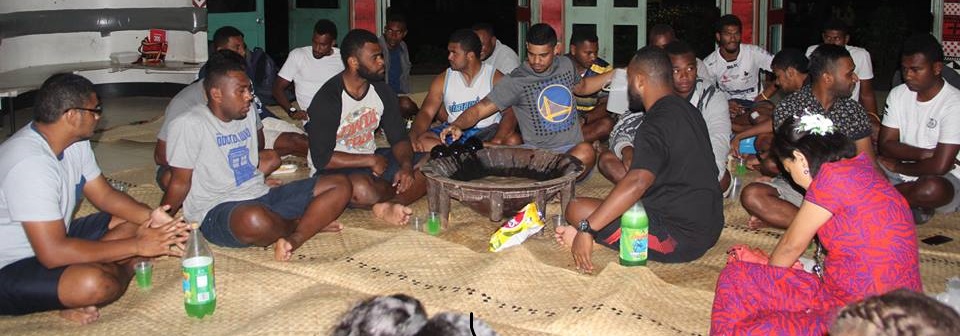
The event was graced by the USP rugby players who shared their views on corruption, integrity and transparency.

The President of FNU Nabua campus, Jone Lovo said that ‘the event was really informative and educational as young people were sharing their views on issues that are sensitive yet crucial to speak about.’

Apart from launching the book, the team also celebrated the International Youths Day, as this year’s theme for the International Youth Day was Safe Spaces; young people present at the event highlighted some of the ways young people can create safe spaces in their communities.

“The theme for International Youth Day reflected the event on Saturday. Young people everywhere are networking with potential collaboration in sharing and creating awareness on Corruption such as the sporting bodies,” said Jofiliti Veikoso the Project Officer of Save the Children, Western Division.

“He further mentioned that, ‘It would be great to bring International National Youth Day again as a public holiday so that there is more visibility of young people and their contribution to society.”
By: Herleen Emily

Fiji Youths: unleashing creative approaches to serious issues

 This blog piece was originally published in the Transparency International website . International Youth Day global snapshot: young… - Tran...